Pursuant to the General Data Protection Regulation (“GDPR”) of European Union, we are committed to protect your data and put you in control. We have updated and will periodically update our Privacy Notice in line with GDPR. See our latest version of the Privacy Notice.
This site uses cookies to offer you a better browsing experience. Find out more on how we use cookies here.


Supply Chain Management

Supplier Structure
The Company’s operational scope includes the design, manufacturing, and assembly of electronic products, as well as the production of plastic injection components and automotive metal die-casting parts. Major raw materials procured include electronic components, plastic pellets, metal sheets, and aluminum ingots.
The Company’s manufacturing bases are primarily located in Taiwan, China, and Vietnam. With the goal of establishing a sustainable supply chain, the Company has developed robust localized supply systems at major operating locations to improve supply efficiency, shorten lead times, and strengthen customer service capabilities. Based on procurement structure analysis, the Company mainly procures through direct suppliers and indirect suppliers (agents/trading companies). Direct suppliers represent the primary procurement source, accounting for 72% overall, including 47% from Tier-1 direct suppliers and 25% from Tier-2 direct suppliers, while indirect suppliers (agents/trading companies) account for 27%. Overall, the Company’s procurement model primarily relies on direct sourcing from original manufacturers, supplemented by procurement through agents to balance supply stability and flexibility. This structure also indicates that supply chain risks are mainly concentrated on the manufacturing side of direct suppliers. Therefore, the Company prioritizes risk control and management enhancement for direct suppliers in sustainable supply chain management.
Local Procurement Priority Policy
In terms of procurement strategy, the Company promotes a local procurement priority principle and encourages suppliers to adopt environmentally and socially responsible production practices. Although certain key components and raw materials still rely on imports, the Company continues to seek sustainable alternative sources to reduce environmental impacts.
The Company deploys procurement strategies according to industrial characteristics and supply conditions in different countries to ensure supply chain stability and resilience. In supply chain management, the Company has established a target requiring subsidiaries to maintain local procurement ratios above 50% in order to reduce transportation risks and costs while promoting local economic development and employment opportunities.
For the proportion of procurement expenditures and the ratio of local procurement from qualified suppliers, please refer to Section 7.2 “Supplier Management” of the Company’s 2025 Sustainability Report.
Material Procurement and Critical Material Risk Management
In terms of critical material identification and management, the Company has established a Product Substance Information Inventory and Management Mechanism based on industry characteristics and product requirements. Suppliers are required to regularly provide product composition declarations, which are used to identify key metals, minerals, and rare earth elements contained in components as the basis for risk assessment and management. Based on risk assessments, the Company has identified cobalt and graphite (primarily used in lithium batteries), tantalum (used in motherboard capacitors), gallium and germanium (used in battery management and communication components), as well as certain rare earth elements such as neodymium and dysprosium (used in cooling fan motors and acoustic components), as high-risk materials due to high supply concentration and significant geopolitical exposure. These materials may face risks of supply disruptions or severe price fluctuations. In addition, indium (used in conductive display materials), tungsten (used in thermal modules), and magnesium (used in mechanical components) are considered medium-risk materials, mainly affected by market supply-demand dynamics and regional supply structures.
In supply chain risk management, the Company has established a comprehensive supplier classification and management mechanism in accordance with the Supplier Management Procedure. Combined with Bills of Materials (BOM) and material risk assessment results, the Company has implemented a Qualified Vendor List (QVL) system as the management basis for material procurement and alternative sourcing. For critical materials and high-risk items, the Company prioritizes establishing multiple qualified supplier sources and simultaneously introduces alternative material evaluation and qualification mechanisms during product design and validation stages to enhance supply flexibility and risk responsiveness. In addition, procurement units adopt diversified risk mitigation measures according to material criticality and supply risk levels, including establishing second-source suppliers, introducing substitute materials, advanced material preparation, and strategic inventory allocation to reduce the operational impacts caused by supply disruptions and price fluctuations. For materials experiencing market shortages or long lead-time conditions, the Company also combines market supply-demand trends and price dynamics to formulate strategic procurement and inventory recommendations, adjusting procurement timing and inventory levels as appropriate to strengthen supply stability and cost control capabilities for critical materials.
At the same time, under the supplier evaluation procedure, the Company has established a supplier performance management mechanism for major suppliers and conducts monthly online TQRDC (Technology, Quality, Responsiveness, Delivery, and Cost) evaluations while continuously tracking improvement progress. In addition, quarterly review meetings are held regarding price fluctuations to monitor market trends and strengthen responsiveness to cost volatility, thereby further enhancing overall supply chain resilience. Before onboarding new suppliers, the Company conducts due diligence reviews and sanction list screening in accordance with the Supplier Management Procedure. Through system-based screening, the Company confirms that suppliers are not included on relevant international sanction lists to ensure compliance and reduce potential legal and operational risks.
In operational and demand management, the Company integrates business forecasts with the Master Production Schedule (MPS) mechanism to strengthen linkage management between demand planning and procurement preparation, improving material planning accuracy and supply stability while reducing operational risks associated with material shortages or excess inventory. Through the above management measures, the Company continues to strengthen critical material management and supply chain resilience to ensure operational stability and enhance sustainable business capabilities.
Supplier Code of Conduct
In accordance with the Responsible Business Alliance (RBA) Code of Conduct, the Company has established the Supplier Code of Conduct, requiring suppliers to jointly comply with the standards and commit to fulfilling corporate social responsibility, protecting fundamental human rights, promoting environmental sustainability, and complying with applicable laws, regulations, and the Company’s supply chain management requirements. To ensure effective implementation, the Company has incorporated the Supplier Code of Conduct into its supplier management system and requires suppliers and their upstream suppliers to jointly comply with relevant requirements. Suppliers are required to commit to the following:
- Complying with integrity and anti-corruption commitments
- Implementing environmental protection and pollution prevention measures
- Respecting labor rights and basic working conditions
- Prohibiting the use of conflict minerals and establishing mineral source traceability mechanisms
- Cooperating with the Company’s supply chain surveys and related audit activities
In terms of policy requirements, the Company requires all Tier-1 and Tier-2 suppliers to sign relevant sustainability commitment documents, including environmental and social responsibility commitment letters, the Responsible Business Alliance (RBA) Code of Conduct, Anti-corruption Undertaking , and declarations regarding the prohibition of conflict minerals and environmentally hazardous substances, to ensure suppliers comply with fundamental principles related to ethical business conduct, human rights protection, environmental protection, and regulatory compliance.
In addition to commitment documents, the Company further strengthens supplier management through systematic review and audit mechanisms. The Supplier Quality Assurance (SQA) unit conducts supplier qualification reviews in accordance with the Supplier Management Procedure and requires suppliers to complete ESG/RBA self-assessment questionnaires to systematically evaluate their management performance in environmental, social, and governance (ESG) areas. The review process combines document reviews with necessary on-site audits to comprehensively evaluate supplier performance in quality management, hazardous substance control, and sustainability-related practices. Suppliers identified as having relatively higher risks based on self-assessment results are subject to further on-site verification to confirm that actual operations comply with the Company’s management standards, serving as a basis for supplier onboarding decisions and subsequent improvement management.
In addition, to strengthen supply chain management, the Company requires raw material suppliers to sign the Long-Term Purchase Agreement and fulfill relevant sustainability and compliance requirements in accordance with contractual obligations, including providing mineral source information and chain-of-custody process details to improve supply chain transparency. If suppliers fail to comply with relevant requirements, the Company may require corrective actions within a specified timeframe in accordance with contractual provisions. Suppliers that fail to complete corrective actions or commit significant violations may have all or part of their business relationships terminated (including transactions or purchase orders), ensuring that supply chain operations comply with sustainability and regulatory requirements.
|
Sustainability Clauses in Getac’s Long-Term Purchase Agreement |
|
|
|
| Getac Group Supplier Management | ||
| Commitment Letter and Contract Signing |
Due Diligence |
Risk Identification |
|
|
|
New Supplier Selection Standards and Audit Results
The Company has established an initial environmental and social screening mechanism for newly onboarded suppliers, incorporating sustainability management requirements into supplier evaluation criteria during the supplier selection stage. In 2025, the Company added a total of 50 new suppliers, including 43 direct suppliers and 7 indirect suppliers. Overall, 78% of the new suppliers signed the RBA Code of Conduct commitment letter. Among direct suppliers, approximately 93% completed qualification screening and related review procedures under environmental and social standards.
Annual Audit Results
Each year, the Company’s quality assurance unit develops an annual audit plan based on the list of active suppliers and dispatches personnel to conduct on-site audits. Audit scope includes quality systems, restricted hazardous substances, environmental protection, and occupational health and safety indicators. Subsidiaries that have implemented the RBA system are also required to complete additional procedures. Suppliers must complete the RBA SAQ (Self-Assessment Questionnaire), and key suppliers are selected for on-site audits based on risk levels. Audit reports are issued with improvement recommendations and implementation timelines. Improvement results serve as the basis for determining whether follow-up audits are required, and suppliers that repeatedly fail to improve may have their supplier qualifications revoked.
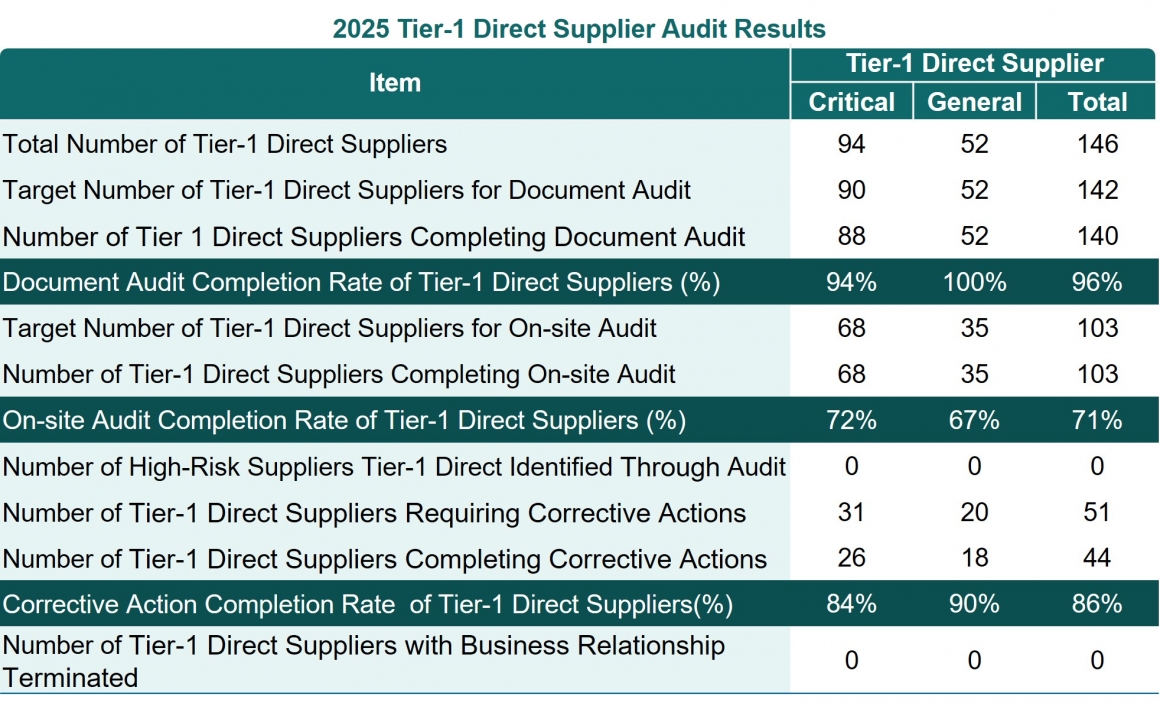
In 2025, the Company had a total of 146 Tier-1 direct suppliers, of which 140 completed document reviews, representing a 96% document review completion rate. In addition, 103 suppliers completed on-site audits, representing an approximately 71% on-site audit completion rate. Audit items covered quality systems, restricted hazardous substances, environmental protection, and occupational health and safety indicators. No major violations related to labor rights, integrity, management systems, or environmental protection were identified among audited suppliers, and no supplier relationships were terminated due to child labor or forced labor violations.
As part of follow-up improvement management, for suppliers identified during the audit process as requiring improvement, the Company assisted a total of 51 suppliers in implementing corrective actions, of which 44 suppliers completed improvements, resulting in an overall improvement completion rate of 86%. This demonstrates that most suppliers were able to cooperate with and implement required corrective measures. The Company also continues to strengthen supplier improvement implementation through ongoing tracking and guidance mechanisms to progressively enhance overall supply chain management standards.
RBA VAP Effectiveness Audit Verification
RBA VAP/CMA audits are internationally recognized verification mechanisms used to evaluate corporate RBA VAP/CMA audits are internationally recognized verification mechanisms used to evaluate corporate sustainability management capabilities in labor practices, human rights, environmental management, and business ethics. Getac Holdings continues to implement the RBA management system across operating sites and obtain relevant audit certifications, while further extending these requirements throughout the supply chain to progressively monitor the RBA VAP verification status of Tier-1 suppliers and strengthen the overall sustainability management maturity of the supply chain.
As of 2025, five subsidiaries under Getac Holdings had implemented the RBA management system and successfully passed RBA CMA or RBA VAP audits, all achieving audit scores above 160 points with no Priority Findings identified. All identified deficiencies had completed corrective actions. Other subsidiaries have also planned subsequent implementation and certification activities to continuously improve the Group’s overall sustainability management standards.
In supply chain management, the Company conducted surveys regarding the RBA audit status of Tier-1 suppliers. In 2025, among Tier-1 suppliers, 28 suppliers completed RBA VAP audits and 16 suppliers completed RBA CMA audits. Among the 28 suppliers completing VAP audits, 26 suppliers achieved scores above 160 points and received Platinum, Gold, or Silver ratings, with no Priority Findings identified, resulting in a 0% priority non-conformance rate.
Prohibition of Conflict Minerals
The Company and its subsidiaries uphold corporate social responsibility and are committed to working with suppliers to promote human rights protection and environmental sustainability. The Company supports and complies with the Responsible Minerals Initiative (RMI) and is committed to avoiding the use of conflict minerals sourced from Conflict-Affected and High-Risk Areas (CAHRAs).
The Company explicitly prohibits the procurement of minerals extracted through armed conflict, illegal exploitation, forced labor, or human rights violations. This policy covers gold (Au), tantalum (Ta), tungsten (W), tin (Sn), cobalt (Co), and their derivative products. Conflict-affected and high-risk areas refer to regions experiencing armed conflict, widespread violence, or other conditions posing significant risks to local populations. In addition, the Company requires all suppliers to:
- Comply with the Company’s conflict minerals policy
- Communicate relevant requirements to their upstream suppliers
- Establish traceable supply chain management mechanisms
- Ensure their supply chains do not directly or indirectly finance armed groups or involve any form of human rights violations or illegal mining activities
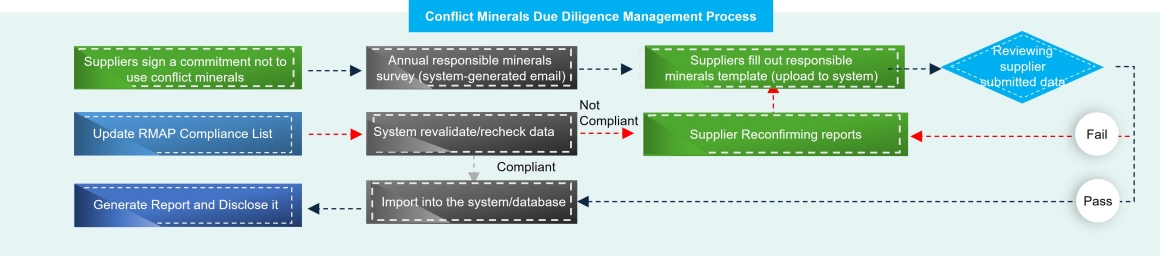
In accordance with the OECD Due Diligence Guidance for Responsible Supply Chains of Minerals from Conflict-Affected and High-Risk Areas, the Company has established a responsible minerals management system and conducts supply chain information collection, risk identification, and management through systematic procedures.
In practice, the Company adopts standardized survey tools provided by the RMI to conduct supply chain due diligence, including:
- Conflict Minerals Reporting Template (CMRT)
- Extended Minerals Reporting Template (EMRT)
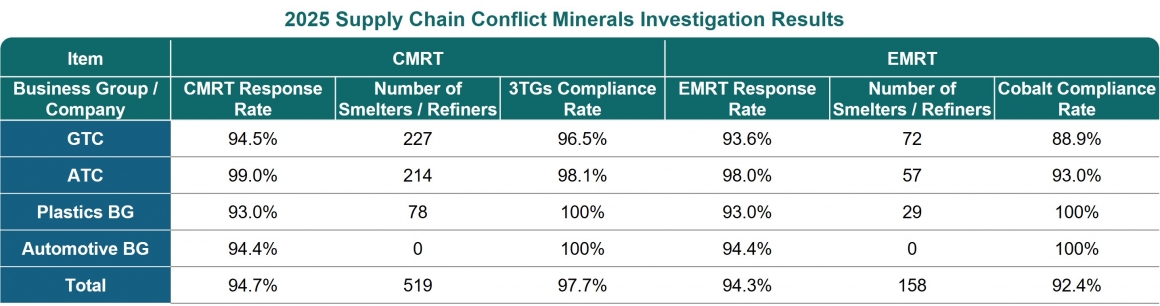
In 2025, the Company continued promoting responsible minerals investigations across major suppliers in all business groups, covering a total of 825 suppliers. The CMRT response rate reached 94.7%, with a 3TGs compliance rate of 97.7%; the EMRT response rate reached 94.3%, with a cobalt compliance rate of 92.4%. For suppliers that did not respond to the survey or whose data required revision, the Company promoted relevant improvement measures and conducted follow-up tracking. In 2025, the CMRT improvement completion rate was 78% for GTC and 63% for ATC; the EMRT improvement completion rate was 68% for GTC and 54% for ATC.









-
We sincerely welcome any suggestions regarding this Report.
Irene Sun
Corporation Relations Office
Email: Getac.csr@getac.com.tw -
Irregular Business Conduct Reporting
Lisa Kung
Director of Auditing Office
Email: gtcaudit@getac.com.tw